Showing posts with label Lucentis. Show all posts

Thursday, May 18, 2017

Avastin Update 5 NIH Considers Trial Comparing Lucentis and Avastin


In my continuing efforts to keep interested people informed on the latest information about Avastin, I requested and received permission to re-publish the following article that originally appeared in the August 7th issue of Ophthalmic Market Perspectives.

NIH Considers Trial Comparing Lucentis and Avastin
By: Dru Thomas, Managing Editor, Ophthalmic Market Perspectives

Amidst a controversy about treatment prices, the NIH is considering funding a study to compare results of AMD therapies with Lucentis and with Avastin.

Lucentis, Genentech's long-awaited anti-angiogenic therapy for age-related macular degeneration (AMD), received FDA regulatory approval on June 30, and the Company immediately shipped $10 million worth of the drug. However, the rosy prospects for Genentech and for wet AMD sufferers took a more convoluted path in mid-July. The US National Institutes of Health (NIH) indicated it was considering funding a clinical study that compares the efficacy of Lucentis with that of Avastin, Genentech's anti-cancer agent that has also shown very positive results in off-label use against wet AMD.

In terms of both science and medical advancement, the two drugs might seem to present a win-win situation, but the reality of the marketplace creates a decidedly more complicated scenario. Genentech, a biotech powerhouse, has created two drugs that may each offer a quantum leap forward in successful AMD treatment, yet the Company faces a unique situation in which its own highly-successful anti-cancer drug may undercut the revenue stream of its proven anti-AMD agent. The crux of the issue is money.

Genentech developed Avastin and received FDA regulatory approval for its use as a systemic treatment for colorectal cancer. Avastin is central to the Company's revenues-both present and future-and the drug is currently involved in scores of trials concerning as many as 25 types of tumors. It is also used off label for some cancers.

Recognizing that the anti-angiogenic Avastin molecule might have potent applications in AMD, Genentech created Lucentis by deriving a fragment from the larger Avastin molecule. This smaller fragment was genetically engineered to create a higher binding affinity than Avastin and to penetrate the retina more effectively when administered by intravitreal injection.

As Lucentis made its way through FDA clinical trials, some doctors were impatient to offer real help to their AMD patients. Buoyed by promising reports regarding the closely-related drugs, they began treating wet AMD patients with intravitreal injections of small amounts of Avastin, an off-label use of the drug. As evidence of positive outcomes accumulated, the practice spread.

Now, with Lucentis available in the marketplace, pricing for AMD therapy is causing quite a stir. Clearly, Genentech has invested significant R&D dollars in both Avastin and Lucentis, including years of testing and clinical trials. Avastin is currently sold as an intravenous treatment and commonly costs a colorectal cancer patient approximately $50,000 per year. Lucentis is injected intravitreally and typically costs an AMD patient between $9,750 and $13,650 per year. But here is the rub-when Avastin is used in the small dosages appropriate for intravitreal injection in AMD patients, the yearly cost is less than $1,000.
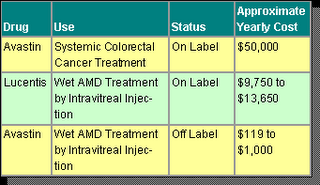

There is an enormous difference in price between these two AMD treatments. As health care providers, insurers and public health systems in many nations feel the pressures of mounting health care costs, there is clearly incentive for further examination of AMD therapy using Avastin.

Meanwhile, the NIH has given no timetable for its decision about funding a comparative study, but if the study takes place and if Avastin is proven to be as effective as Lucentis, findings may jeopardize Lucentis' future earnings. However, these are big "ifs," and any study will take years to conduct. At present, doctors may choose between two Genentech drugs that appear to be remarkably effective against wet AMD. One, Lucentis, is used on label and is eligible for reimbursement; the other, Avastin, involves non-reimbursable, off-label use that might increase a doctor's liability if anything goes wrong. For the time being, Lucentis has a clear edge in the marketplace.

(Reprinted with permission from Market Scope. For information on subscribing to Ophthalmic Market Perspectives, please go to www.marketscope.com.)

Author’s Note on Avastin

Since the original posting on January 31, 2006, I have now added eight updates on this important drug for treating age-related macular degeneration. In addition to the posting you are reading, here is a listing (with links) to the others:

Avastin: A New Hope for Treating AMD (January 2006)

Avastin Update: Medicare not Likely to Cover its Use (March 2006)

Avastin Update II: AAO supports Medicare Coverage for Off-label Avistan Use (April 2006)

ARVO 2006: A Further Update on Both Avastin and Lucentis for Treating AMD (May 2006)

Avastin/Lucentis Update 4: FDA Approves Lucentis for Treating Wet AMD (July 2006)

Avastin/Lucentis Update 6: Latest Results Published in NEJM and Another Call for a Trial Between Them (October 2006)

Avastin/Lucentis Update 7: BREAKING NEWS – NEI/NIH Will Fund Comparative Study (October 2006)


Sunday, January 8, 2017

CATT Study Update 4 Avastin vs Lucentis Study Ready to Roll


On the eve of the American Academy of Ophthalmology meeting in New Orleans, scheduled to begin tomorrow (November 9-14), the Center for Preventative Ophthalmology and Biostatistics at UPenn has finally updated their website on the CATT Study. The website now contains almost everything you need to know about the study.

In particular: What Is Neovascular AMD and Why Is the CATT Study Important?

This section provides an explanation of what AMD is and how it is treated, along with some information about the CATT Study, its design and aims.

The Study’s primary aim is to evaluate the relative safety and efficacy of treatment of subfoveal AMD with both Avastin and Lucentis, determine an appropriate dosing schedule and, to see if there is any clinical difference between the two drugs. Some of the secondary aims include:

  • Determination of the number of treatments required at 1 and 2 year periods
  • Determination if either or both drugs provide a 3-line change in visual acuity (15 letters on ETDRS chart)
  • Changes in subretinal and intraretinal fluid on OCT examination
  • Changes in lesion size on fluorescein angiograph examination
  • Incidence of any complications of treatment (endophthalmitis, retinal detachment, cataract, uveitis)
  • Incidences of other adverse effects
  • Comparison of the cost of treatment over two years

There are two links within the document: one describes the eligibility requirements, while the second is a 258 page Manual of Procedures, which contains everything your ever wanted to know about the CATT Study.

The only changes I noted from the original information I have provided are that enrollment is now scheduled to begin January 1st, and the number of clinical sites has been reduced to 44. The location of the 44 sites is not provided on the website (yet), but hopefully will be included soon.

In any event, I have a prior list of 45 sites which presumably contains all of the sites scheduled to participate. Anyone wishing to know what sites are participating in their states can email me and I will be happy to provide a list for that state. (My email link is shown in the sidebar.)

Tuesday, May 31, 2016

Avastin Lucentis Update 36 More on Possible Problems with Pharmacy Compounding of Avastin


Last October 27th, I first reported on the disturbing news about particulate matter causing IOP spikes following Avastin injections, as reported during the 2009 AAO Meeting by Dr. Malik Kahook. Well, Dr. Kahook expanded on his remarks at the Royal Hawaiian meeting in January (Hawaiian Eye 2010), which first appeared on the OSN Supersite on January 21st. The editors of OSN Supersite have now updated his remarks and re-published them today.

Here is the updated commentary, as reported by OSN Supersite 2-25-10:

Particulates in long-stored bevacizumab may cause spike in IOP

KOLOA, Hawaii — Bevacizumab stored for long periods of time under suboptimal conditions showed evidence of increased large particulate matter, possibly resulting in increased IOP after intravitreal injection, a presenter here said. Malik Y. Kahook, MD

"Avastin is not formulated for sitting in a plastic syringe for an extended period of time. It is also not formulated for sitting in a plastic syringe that has a rubber stop in it. Exposure to light can also change the properties of stored bevacizumab. So all of these things are influencing what we are seeing," Malik Y. Kahook, MD, said at Hawaiian Eye 2010.

In 2007, the first reported case of increased IOP due to anti-VEGF treatment was published, he said. Since then, there have been at least 56 published reports showing IOP spikes of up to 40 mm Hg to 50 mm Hg in age-related macular degeneration patients treated with Avastin (bevacizumab, Genentech) and/or Lucentis (ranibizumab, Genentech).

Dr. Kahook and colleagues looked at a variety of possible explanations, such as inflammation, toxicity and concentration, but none explained the complication.

While the concentration of bevacizumab in syringes decreased after storage, Dr. Kahook used micro-flow imaging to show that the particles per million in the bevacizumab actually increased. In samples obtained from a single compounding pharmacy, the researchers found there was 10 times more large particulate matter. The exact nature of these particles is still under investigation, he said.

"I want to make it clear that these medications have been extremely beneficial for diseases like wet age-related macular degeneration, as well as neovascular glaucoma and that the anti-VEGF agents themselves appear to be safe and well-tolerated," Dr. Kahook said. "Despite the excellent safety profile we have seen some complications and in particular the increase in IOP in patients after receiving single or multiple injections of either Avastin or Lucentis.

"While IOP spikes have been seen with Lucentis, it is much more frequent in patients receiving Avastin injections, and we have not seen a large number of particulate matter in the syringes of Lucentis that we have studied.

"It does appear that the Avastin repackaging process in some cases is not ideal and can be improved upon," he said.

Dr. Kahook suggested ophthalmologists should learn more about their source of repackaged bevacizumab, ask for syringes stored for less than 2 weeks and keep syringes in the refrigerator until needed. He also suggested not shaking or tapping the syringes and possibly buying one's own vial rather than buying the repackaged syringes.

Editor's note: This is an updated version of an article that appeared on the OSN SuperSite on Jan. 21, 2010.