Showing posts with label 5. Show all posts

Monday, May 22, 2017

5 Ways Yoga Can Affect Your Health


by Baxter
Roots by Melina Meza
On this blog, we often address the health benefits of yoga, from its ability to support a generally healthy lifestyle to specific therapeutic benefits that yoga brings to a whole array of injuries, diseases, and conditions (see Common Minor Problems That Yoga Can Help With and Common Serious Problems That Yoga Help With). Therefore, how we are using yoga for health benefits can vary tremendously. So I feel it will be helpful to have a clear framework to describe yoga’s various roles in affecting our health. This will give us a better understanding of what yoga actually has the power to do—or not—for different types of conditions.

Within the world of yoga, yoga therapy is a rapidly emerging specialty. It is interesting to consider the origins of the word “therapy.” It comes originally from the Greek language, and literally means “healing” or “curing.” As I considered how yoga fits into modern concepts of healing and treatment for conditions and ailments, I came up five different categories. 

1. Preventative Medicine. Yoga can be “health promotion activity” that can prevent disease and create an overall sense of well-being. In choosing to practice yoga, you may not be targeting a specific disease or condition, but rather in a more general way you are promoting your general health and supporting a sense of well-being. We could say that in this way, yoga is acting as a form of primary prevention, addressing your overall health before any problems develop. Yoga can also be a form of secondary prevention for specific conditions that are present in a latent form or a presently asymptomatic, but if were left unaddressed, could progress to a more serious form. High blood pressure is one example of this. If we apply yoga to high blood pressure and it helps to normalize our blood pressure numbers, it could prevent the development of more serious conditions like Coronary Artery Disease and heart attacks. In this case, ongoing yoga practice will hopefully prevent future disability from the more serious consequences of untreated high blood pressure. 

2. Curative Medicine. Yoga certainly can help with complete healing, as is often noted with musculoskeletal conditions, such as common sprains and strains, and even more complex issues, such as back and neck pain. In addition, in some individuals, yoga seems to resolve serious issues like anxiety and depression, although it often does so as an “adjunct,” in combination with other forms of treatment. However, unlike an antibiotic prescribed for a specific infection for which it cures, yoga usually is not just used for two weeks and then discarded. So there is an ongoing “maintenance” aspect of yoga that differs from western pharmaceutical treatments. And before prematurely pronouncing yourself “cured,” you might consider monitoring your “cured” conditions for 1 to 5 years as they do with cancer treatment.

3. Maintenance Therapy. Yoga can be helpful as a maintenance treatment for ongoing conditions that are in a remission state. For example, someone with MS can practice yoga between flares of symptoms in order to help maintain the relative symptom-free remission periods. Or someone with asthma during could practice during symptom-free periods with the goal of extending those remission times. During flares, people with these types of conditions might also do a modified, gentle, restorative practice, which would fall into our next category.

4. Supportive or Palliative Therapy. T
his type of therapy provides comfort care for the patient without treating the underlying condition. While palliative care  refers to serious or terminal conditions, it is related to supportive therapy. As an example, some of my students with chronic low back pain, often from ruptured discs that are not going to heal, benefit dramatically from the pain and stress-relieving aspects of their ongoing yoga practice. And for more serious situations, I think of a student of mine who had Lou Gehrig’s Disease, and used his pranayama and meditation practices even into the last stage of his life with some benefit.

5. Rehabilitative Therapy. Yoga is being used more and more to aid recovery from all sorts of acute conditions, such as following major surgeries to post-heart attack and post-stroke rehabilitation. In such cases, yoga is often introduced for certain periods of time, say two to four months, to accelerate recovery, and hopefully adopted for longer-term maintenance or supportive purposes after that.

Now, you might want to add more categories, or divide some of these into several, but my hope is that this organization, however simple, helps you to think in a clearer fashion about how you apply your yoga to health conditions. 

Subscribe to Yoga for Healthy Aging by Email ° Follow Yoga for Healthy Aging on Facebook ° Join this site with Google Friend Connect

Thursday, May 18, 2017

Avastin Update 5 NIH Considers Trial Comparing Lucentis and Avastin


In my continuing efforts to keep interested people informed on the latest information about Avastin, I requested and received permission to re-publish the following article that originally appeared in the August 7th issue of Ophthalmic Market Perspectives.

NIH Considers Trial Comparing Lucentis and Avastin
By: Dru Thomas, Managing Editor, Ophthalmic Market Perspectives

Amidst a controversy about treatment prices, the NIH is considering funding a study to compare results of AMD therapies with Lucentis and with Avastin.

Lucentis, Genentech's long-awaited anti-angiogenic therapy for age-related macular degeneration (AMD), received FDA regulatory approval on June 30, and the Company immediately shipped $10 million worth of the drug. However, the rosy prospects for Genentech and for wet AMD sufferers took a more convoluted path in mid-July. The US National Institutes of Health (NIH) indicated it was considering funding a clinical study that compares the efficacy of Lucentis with that of Avastin, Genentech's anti-cancer agent that has also shown very positive results in off-label use against wet AMD.

In terms of both science and medical advancement, the two drugs might seem to present a win-win situation, but the reality of the marketplace creates a decidedly more complicated scenario. Genentech, a biotech powerhouse, has created two drugs that may each offer a quantum leap forward in successful AMD treatment, yet the Company faces a unique situation in which its own highly-successful anti-cancer drug may undercut the revenue stream of its proven anti-AMD agent. The crux of the issue is money.

Genentech developed Avastin and received FDA regulatory approval for its use as a systemic treatment for colorectal cancer. Avastin is central to the Company's revenues-both present and future-and the drug is currently involved in scores of trials concerning as many as 25 types of tumors. It is also used off label for some cancers.

Recognizing that the anti-angiogenic Avastin molecule might have potent applications in AMD, Genentech created Lucentis by deriving a fragment from the larger Avastin molecule. This smaller fragment was genetically engineered to create a higher binding affinity than Avastin and to penetrate the retina more effectively when administered by intravitreal injection.

As Lucentis made its way through FDA clinical trials, some doctors were impatient to offer real help to their AMD patients. Buoyed by promising reports regarding the closely-related drugs, they began treating wet AMD patients with intravitreal injections of small amounts of Avastin, an off-label use of the drug. As evidence of positive outcomes accumulated, the practice spread.

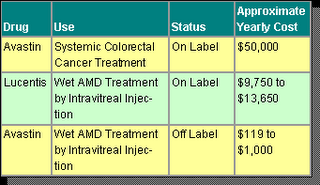
Now, with Lucentis available in the marketplace, pricing for AMD therapy is causing quite a stir. Clearly, Genentech has invested significant R&D dollars in both Avastin and Lucentis, including years of testing and clinical trials. Avastin is currently sold as an intravenous treatment and commonly costs a colorectal cancer patient approximately $50,000 per year. Lucentis is injected intravitreally and typically costs an AMD patient between $9,750 and $13,650 per year. But here is the rub-when Avastin is used in the small dosages appropriate for intravitreal injection in AMD patients, the yearly cost is less than $1,000.


There is an enormous difference in price between these two AMD treatments. As health care providers, insurers and public health systems in many nations feel the pressures of mounting health care costs, there is clearly incentive for further examination of AMD therapy using Avastin.

Meanwhile, the NIH has given no timetable for its decision about funding a comparative study, but if the study takes place and if Avastin is proven to be as effective as Lucentis, findings may jeopardize Lucentis' future earnings. However, these are big "ifs," and any study will take years to conduct. At present, doctors may choose between two Genentech drugs that appear to be remarkably effective against wet AMD. One, Lucentis, is used on label and is eligible for reimbursement; the other, Avastin, involves non-reimbursable, off-label use that might increase a doctor's liability if anything goes wrong. For the time being, Lucentis has a clear edge in the marketplace.

(Reprinted with permission from Market Scope. For information on subscribing to Ophthalmic Market Perspectives, please go to www.marketscope.com.)

Author’s Note on Avastin

Since the original posting on January 31, 2006, I have now added eight updates on this important drug for treating age-related macular degeneration. In addition to the posting you are reading, here is a listing (with links) to the others:

Avastin: A New Hope for Treating AMD (January 2006)

Avastin Update: Medicare not Likely to Cover its Use (March 2006)

Avastin Update II: AAO supports Medicare Coverage for Off-label Avistan Use (April 2006)

ARVO 2006: A Further Update on Both Avastin and Lucentis for Treating AMD (May 2006)

Avastin/Lucentis Update 4: FDA Approves Lucentis for Treating Wet AMD (July 2006)

Avastin/Lucentis Update 6: Latest Results Published in NEJM and Another Call for a Trial Between Them (October 2006)

Avastin/Lucentis Update 7: BREAKING NEWS – NEI/NIH Will Fund Comparative Study (October 2006)


Monday, March 27, 2017

5 Many Efficient Pointer For Your Weight Loss Exercise


By Ram Gupta


If you have actually chosen that consistent exercise is the method to accomplishing your weight loss objectives, you are on the right track. What you should consider now is ways to draw maximum gain from your weight loss exercise. Right here are some ideas that will assist you focus on the right things, no matter exactly what the specific kind of exercise you have actually chosen.

1. Choose a Workout you Take pleasure in

This is crucial, if you wish to sustain your efforts. Whenever you stumble upon an actual miracle of long reducing weight tale, you will usually discover that the individual in question enjoyed their exercise. The concept is that your weight loss exercise must be fascinating adequate to do for its own sake, instead of an obligation. So, if it is a sport you delight in, concentrate your efforts around that. If biking is your thing, sign up with a bike club.

2. High Intensity, Short Period

Most people believe that exercise have to be a long and protracted effort, in order to work as a fat loss workout. The truth is that if you continue working out when you are already fatigued, you will really not acquire much out of it. Higher intensity and much shorter duration weight loss exercises are a lot more reliable, effective and even useful as far as time constraints go.

You burn more calories per minute and provide your muscles a larger challenge. This will assist your muscles strengthen up faster and offer an actual boost to your metabolic rate. The principle of shorter and more extreme workouts works for both cardiovascular along with weightlifting workouts.

3. Build a Base First

When there is no foundation, a framework will collapse. This puts on your body too. So, before you crank up the intensity with your workouts, see to it you offer your body a minimum of a month to adapt to this new difficulty. So, if you are beginning with jogging or cycling, the first month should include moderate to low intensity efforts, which means you shouldn't be getting breathless during the exercise. Similarly, if you are doing any form of weightlifting, for the first month you should be focusing on getting the right kind rather than lifting any heavy weights.

Gradually build up to a level where your body can handle greater intensity spells. After that, you have a clear passage to your weight loss objectives!

4. Not the Same Thing Everyday

A great deal of individuals make this error with their weight loss exercises. When your body adjusts to a certain exercise, it becomes more effective at it, meanings that you burn less calories throughout the effort and start to stagnate with your weight loss goals. Keep giving your body new challenges. That is the only way to climb the ladder to physical fitness and weight loss success. So, instead of doing the very same 3 k jog daily, include bursts of faster runs one day of the week, some uphill running on an additional day, and some kind of strengthening exercises on the weekend.

5. Not Everyday

Working out everyday can be disadvantageous to your physical fitness and weight loss goals. Rest is important for the body. That is when the muscles repair, adjust and grow. Without more than enough rest, you will expose yourself to injury and physical and mental fatigue, and your fat loss workout will not be sustainable. Preferably, you should give your body 1-3 days of complete rest in a week, depending on the kind and intensity of workout you are doing.

With these five suggestions, rest assured that you will be drawing maximum efficiency from your weight loss workout.


About the Author:


Tuesday, May 17, 2016

5 Best Herbal Treatments For Natural Home Remedies For Stopping Health Issues


By Al Dancel


Perhaps you have become sick but didn't want to pay for to go to the doctor or perhaps the pharmacy? The reality is, there is no need a health care provider or perhaps the pharmacy knowing how to use certain herbal remedies as a home solution.

5 herbal remedies listed below are actually used as herbal remedies for very long time to think about proper care of common health problems. These herbal medicines are cheap, don't cause harmful undesirable effects, and is easily used without departing your home.

Lavender - Area of the daisy family, lavender has remarkable health advantages many people have no idea about. The antibacterial and anti-oxidants qualities present in this plant will help you effectively treat various infections as well as assist in preventing some cancer. Lavender also offers a soothing effect that's been used to help relieve stress, motion sickness, insomnia, and anxiety problems.

Echinacea - Echinacea is considered the most used herbal remedies because of its many health improvements. This plant is principally familiar with taking proper care of typically the most popular cold as well as the flu as it is a great defence systems booster. Once your defence system is much more effective it might be more effective at fighting not only the cold, but furthermore candida albicans, microbe infections, and certain cancer.

Burdock Root - Burdock is a plant that is mainly found in areas of Europe. Since burdock root is packed with antioxidants it can help prevent certain cancers by killing cancer cells.

Ginseng - Individuals in China have been aware of the astonishing health advantages of ginseng for a long time to deal with various conditions like diabetes, bloodstream pressure, cardiovascular disease, and head aches. You will find several types of ginseng available but it is best to choose the American or Panax for health issues.

Lavender - The lavender plant is very aromatic, which explains why it's the most important component in several fragrances around the globe. Not only might be the scent of lavender sufficient for scents, but it's many health improvements ensure it is ideal for coping with and preventing conditions.

Essentially these are the top 5 herbal remedies you need to use for home cures. Clearly, there are plenty more herbal remedies available that have exceptional healing abilities. The next time you're feeling somewhat sick look around your kitchen because you can currently have one of these brilliant herbal remedies handy.


About the Author: