Showing posts with label Trial. Show all posts

Thursday, May 18, 2017

Avastin Update 5 NIH Considers Trial Comparing Lucentis and Avastin


In my continuing efforts to keep interested people informed on the latest information about Avastin, I requested and received permission to re-publish the following article that originally appeared in the August 7th issue of Ophthalmic Market Perspectives.

NIH Considers Trial Comparing Lucentis and Avastin
By: Dru Thomas, Managing Editor, Ophthalmic Market Perspectives

Amidst a controversy about treatment prices, the NIH is considering funding a study to compare results of AMD therapies with Lucentis and with Avastin.

Lucentis, Genentech's long-awaited anti-angiogenic therapy for age-related macular degeneration (AMD), received FDA regulatory approval on June 30, and the Company immediately shipped $10 million worth of the drug. However, the rosy prospects for Genentech and for wet AMD sufferers took a more convoluted path in mid-July. The US National Institutes of Health (NIH) indicated it was considering funding a clinical study that compares the efficacy of Lucentis with that of Avastin, Genentech's anti-cancer agent that has also shown very positive results in off-label use against wet AMD.

In terms of both science and medical advancement, the two drugs might seem to present a win-win situation, but the reality of the marketplace creates a decidedly more complicated scenario. Genentech, a biotech powerhouse, has created two drugs that may each offer a quantum leap forward in successful AMD treatment, yet the Company faces a unique situation in which its own highly-successful anti-cancer drug may undercut the revenue stream of its proven anti-AMD agent. The crux of the issue is money.

Genentech developed Avastin and received FDA regulatory approval for its use as a systemic treatment for colorectal cancer. Avastin is central to the Company's revenues-both present and future-and the drug is currently involved in scores of trials concerning as many as 25 types of tumors. It is also used off label for some cancers.

Recognizing that the anti-angiogenic Avastin molecule might have potent applications in AMD, Genentech created Lucentis by deriving a fragment from the larger Avastin molecule. This smaller fragment was genetically engineered to create a higher binding affinity than Avastin and to penetrate the retina more effectively when administered by intravitreal injection.

As Lucentis made its way through FDA clinical trials, some doctors were impatient to offer real help to their AMD patients. Buoyed by promising reports regarding the closely-related drugs, they began treating wet AMD patients with intravitreal injections of small amounts of Avastin, an off-label use of the drug. As evidence of positive outcomes accumulated, the practice spread.

Now, with Lucentis available in the marketplace, pricing for AMD therapy is causing quite a stir. Clearly, Genentech has invested significant R&D dollars in both Avastin and Lucentis, including years of testing and clinical trials. Avastin is currently sold as an intravenous treatment and commonly costs a colorectal cancer patient approximately $50,000 per year. Lucentis is injected intravitreally and typically costs an AMD patient between $9,750 and $13,650 per year. But here is the rub-when Avastin is used in the small dosages appropriate for intravitreal injection in AMD patients, the yearly cost is less than $1,000.
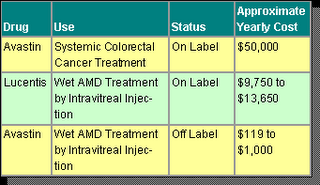

There is an enormous difference in price between these two AMD treatments. As health care providers, insurers and public health systems in many nations feel the pressures of mounting health care costs, there is clearly incentive for further examination of AMD therapy using Avastin.

Meanwhile, the NIH has given no timetable for its decision about funding a comparative study, but if the study takes place and if Avastin is proven to be as effective as Lucentis, findings may jeopardize Lucentis' future earnings. However, these are big "ifs," and any study will take years to conduct. At present, doctors may choose between two Genentech drugs that appear to be remarkably effective against wet AMD. One, Lucentis, is used on label and is eligible for reimbursement; the other, Avastin, involves non-reimbursable, off-label use that might increase a doctor's liability if anything goes wrong. For the time being, Lucentis has a clear edge in the marketplace.

(Reprinted with permission from Market Scope. For information on subscribing to Ophthalmic Market Perspectives, please go to www.marketscope.com.)

Author’s Note on Avastin

Since the original posting on January 31, 2006, I have now added eight updates on this important drug for treating age-related macular degeneration. In addition to the posting you are reading, here is a listing (with links) to the others:

Avastin: A New Hope for Treating AMD (January 2006)

Avastin Update: Medicare not Likely to Cover its Use (March 2006)

Avastin Update II: AAO supports Medicare Coverage for Off-label Avistan Use (April 2006)

ARVO 2006: A Further Update on Both Avastin and Lucentis for Treating AMD (May 2006)

Avastin/Lucentis Update 4: FDA Approves Lucentis for Treating Wet AMD (July 2006)

Avastin/Lucentis Update 6: Latest Results Published in NEJM and Another Call for a Trial Between Them (October 2006)

Avastin/Lucentis Update 7: BREAKING NEWS – NEI/NIH Will Fund Comparative Study (October 2006)


Wednesday, September 21, 2016

Field Guide to OCD Feeling on Trial


Courtroom
I feel like I'm on trial by OCD. This is one of the clues to recognizing being in the OCD. The OCD thrusts the burden of proof on me. I must prove all things beyond any reasonable doubt, which of course, OCD doesn't ever recognize. When I started Exposure Therapy, my OCD had a lot of power and credibility.

Right now, I am on the computer, after being on Skype. I called at 8:00 am, the time I used to start work when I was employed, and once I got off the phone, I was back in my old work pattern of compulsion, which was to stay on the computer, in a kind of trance, because anything else I might do could be the "wrong" thing, and I would be in for harsh cross-examination from my OCD thinking. I'm doing my mental rituals of checking of what time it is, how many minutes have passed, diverted into the "why am I doing this? What is wrong with me?" line of questioning, followed by, "you can't undo this. you've ruined your day, you can't salvage it. you suck."

This adversarial mode adds more fuel to the OCD fire. And OCD talks a confident way, a dictatorial, demanding way that is intimidating, and uses a kind of brute force, saying the same thing over and over, louder and louder. What if! What if! What if!

A cross-examination complete with, "Just answer the question. Don't explain. Just answer yes or no. Strike everything else from the record." What if I am fucking up my life? What if I am making a horrible mistake? What if I really am bad? What if I don't really deserve any compassion? What if I am wasting my life and this is unforgiveable? What if I am beyond redemption?

Often my own thinking seems pallid and inconsequential, signifiying nothing, powerless. But it's my own thinking that allowed me to get into treatment, and start doing things with my life, and learn to have compassion for myself. This is the act of faith, to trust the quiet still voice, without knowing for sure if it really is my own thinking--the OCD chips away at that too, demanding I know for certain if I'm thinking for myself or if it's OCD.

This is crazymaking stuff. Depending on the context, the my current line of questioning can completely contradict another line of questioning from just a second before. From "Don't trust your thinking" to "What's wrong with you that you don't trust your own thinking?" to "Ok. But are you sure this is your own thinking and not the OCD?"

What is the fruit of your OCD? What kind of fruit does it bear? Does it bring peace or joy or meaning to your life? If I am brave and take a minute to observe, I can see the destruction it wreaks, the poisonous fruit OCD bears, the mess my life became when I was totally in grips of it. OCD certainly promises peace, and promises if I just stay at the computer and answer all the questions, that I will avoid the turmoil of getting up, and facing my day in a backlash of obsessiveness, but I know from experience, if I stay on the computer a few more hours, until my back hurts, and I've thoroughly exhausted myself and my mood has deteriorated, that any peace I get is an illusion.

Tuesday, September 6, 2016

Stem Cells in Ophthalmology Update 21 Clinical Trial Details


As with my inquiry into clinical trials underway using gene therapy in ophthalmology, Table 3 Gene Therapy in Ophthalmology - Ongoing Clinical Trial Details, I have undertaken a similar survey of the number of patients currently treated using stem cells. I found nine ongoing clinical trials and one about to begin.

As in the previous study, I visited the clinical trial information sites and extracted the pertinent information for use in this table, Table 3. Stem Cell Therapy in Ophthalmology - Ongoing Clinical Trial Details.

I then contacted each of the principals or sponsor involved in the study and requested the number of patients treated to date. The response to date has not been as good as with the gene therapy trials, but here is what I was able to find out.

Only two companies/institutions involved answered my request, and so I can only reliably report that 17 patients have been given stem cells for treatment of ophthalmic disorders to date.

I hope to gather additional information from either the clinical investigators or others and will update this table as new information is obtained.

Here, then, is the initial version of this table.


A downloadable pdf file of the above table is available by request.

To obtain copies of the current versions of the first two tables, listed below, please send me an email.

Table 1. Stem Cell Companies/Institutions Active in Ophthalmology

Table 2. Stem Cell Therapy in Ophthalmology by Application